Project Management

Good task management is the invisible backbone of every campaign that ships on time — and when it breaks down, the damage goes far beyond a missed deadline. It erodes something harder to rebuild: trust. Your founder trusted you to get the landing page live by Thursday. Your freelance designer trusted that the brief you promised would arrive Monday morning. Your social media contractor trusted that approvals would come through before the window closed. When those promises disappear into a thread nobody can find, the work suffers — and so does every relationship on the team.
This is not a story about laziness or bad intentions. It is a story about how task management falls apart under the specific pressure of small marketing teams: too many conversations, too many tools, and commitments made verbally or in passing that never get captured anywhere actionable. The promise exists. The task does not.
If you manage marketing at a small business, you know this pattern intimately. Let this article walk you through exactly where the breakdown happens, a repeatable workflow to stop it, and the failure points to watch for before they cost you a campaign — or a colleague's confidence in you.
The Campaign Morning That Went Sideways
Picture this: it is 8:45 a.m. on launch day. You are ready to push a product promotion live. You need the final ad copy from your copywriter, the approved graphic from your founder, and the UTM-tagged link from the freelancer who built the landing page. You are certain all three were agreed upon in last Tuesday's kickoff call.
The copywriter says she never got a formal brief — she thought the founder was handling that section. The founder cannot find the feedback he left on the graphic because it was buried in an email chain he mislabeled. The freelancer delivered the landing page link to a Slack channel that the rest of the team stopped checking two weeks ago. By 11 a.m., you have three stakeholders each holding a piece of the puzzle, none of them aware the others are stuck. The promotion goes out four hours late, the morning traffic window is gone, and the post-mortem conversation is uncomfortable for everyone.
Nothing about this scenario is unusual. It is what happens when promises made in meetings and chat threads never convert into tracked, owned, visible tasks.
Where Task Management Breaks Down on Small Marketing Teams
The problem is not that your team is disorganized. It is that task management on a lean team is constantly competing with the pace of conversation. Work gets decided faster than it gets documented. Here is where the gaps open up.
Promises Made in Meetings Never Become Tasks
Every campaign kickoff produces a cluster of verbal commitments: "I will get you the brief by Friday," "Let me loop in the designer on that," "I will check with the founder and come back to you." These statements feel like agreements. In reality, they are only intentions — and intentions without task tracking have no due date, no owner, and no visibility. They exist only in someone's memory or a set of personal notes nobody else can see.
Feedback Lives Somewhere Nobody Can Find It
Approval workflows on small teams tend to be improvised. The founder leaves a comment on a Google Doc. The copywriter gives feedback in email. The designer responds in a direct message. When you need to compile the final approved version, you are archaeology-ing across four platforms. The work was done. The decisions were made. But because task management was never centralized, the context is scattered beyond practical use.
Freelancers Fall Through the Cracks
Freelancers operate outside your daily rhythm. They deliver when they are done, not when you check in. Without a shared task tracking system, their deliverables land in inboxes or shared drives with no connection to the campaign milestone they unlock. The file exists. Nobody knows it arrived.
The table below maps these common breakdowns against what a structured task management approach looks like instead.
Where promises break down | Without structured task management | With structured task management |
|---|---|---|
Meeting commitments | Verbal only, lives in someone's memory | Converted to a task with owner and due date immediately |
Approval feedback | Scattered across email, docs, DMs | Attached directly to the relevant task, visible to all stakeholders |
Freelancer deliverables | Dropped in an inbox or drive with no context | Delivered against a task, status updated to Review automatically |
Campaign context | Rebuilt from memory before every check-in | Stored in task history, searchable at any point |
A Repeatable Workflow: The Promise-to-Task Play
The fix is not a heavyweight project management overhaul. It is one disciplined habit: every commitment made in a meeting, message, or email gets converted into a task before the conversation ends. Here is how to run that as a five-step play your whole team can follow.
Capture every commitment at the moment it is made. During a kickoff call or review meeting, have one person whose only job is to log promises as they happen. Not in notes. Directly into your task management system. The task gets a name, an owner, and a due date before the call ends. If the due date is unknown, the task owner's first job is to confirm it within 24 hours.
Attach the context the task needs to be completed. A task called "Write ad copy" is incomplete. The task should link to the brief, the brand guidelines, the campaign goal, and any reference examples. Whoever picks it up next week — or your freelancer reading it for the first time — should be able to start without asking a single clarifying question.
Build one approval step into the task itself. Instead of routing feedback through email, make approval a stage in the task workflow. When a deliverable is ready, the status moves to Review. The founder or approver gets notified. Their feedback lands inside the task comment thread, not in a separate channel. Nothing gets lost.
Set a visible deadline and a one-day buffer. Every task should have a hard due date visible to the whole team, plus a personal reminder the owner sets for themselves 24 hours earlier. That buffer catches the tasks that slip quietly — the ones nobody chases until it is too late.
Close the loop explicitly. When a task is done, the owner marks it complete and posts a one-line summary: "Landing page live, UTM link confirmed, shared in campaign folder." This sounds small. It is not. That single line is what tells the rest of the team that the domino has fallen and their next step can begin. Without it, task management stalls at the handoff.
Common Failure Points — and How to Head Them Off
Even teams with good intentions run this workflow into the ground. Watch for these specific failure modes.
The founder never logs in to approve
This is the most common bottleneck on small marketing teams. Founders move fast, communicate in bursts, and rarely live inside a task management tool. The fix: reduce the approval action to a single tap. Tag the founder directly in the task comment with a clear question and a deadline. If your tool sends a notification to their phone, even better. Do not ask them to navigate anywhere — bring the decision to where they already are.
Tasks get created but never updated
A task board full of "In Progress" items that have not moved in a week is worse than no board at all. It creates false confidence. Set a team norm: if a task has not been updated in 48 hours, the owner posts a one-sentence status. Not a full report — just "waiting on client photo assets" or "draft done, needs review." This keeps task tracking honest without adding meeting overhead.
Freelancers operate in a separate system
If your freelancers deliver work through email or a personal drive folder, you will always have a gap between what they finished and what the internal team knows about. Bring freelancers into your task management workspace with limited access to the projects they are on. Their deliveries happen inside the task. The whole team sees it. No one has to relay information manually.
Context disappears when someone leaves the team
When a freelancer wraps up and moves on, the campaign history that lived in their head or their personal notes walks out the door with them. Task management that stores decisions, files, and commentary directly in the task record means that context stays with the campaign — not the person.
How Morningmate Keeps Promises Visible: A Worked Example
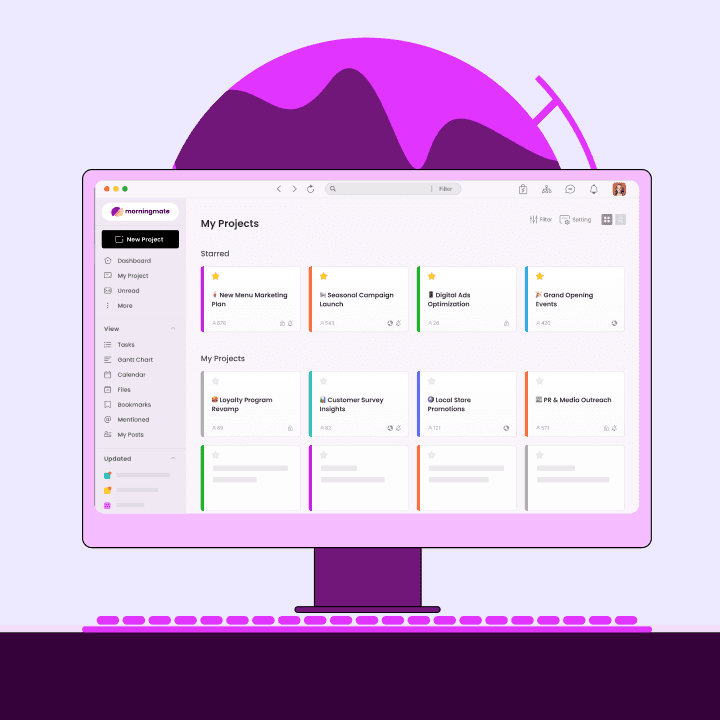
Here is how this plays out on a real campaign using Morningmate, a lightweight work management tool built for teams who need task management, approvals, and communication in one place without the complexity of enterprise software.
Imagine your team is launching a summer sale campaign. On Monday's kickoff call, four deliverables get committed: ad copy, a hero graphic, a landing page, and a founder-approved email subject line. In Morningmate, each commitment becomes a task inside the campaign project within minutes of the call ending. Each task gets an owner, a due date, and the relevant brief attached directly in the task description.
When the freelance designer finishes the hero graphic on Wednesday, she posts the file in the task comments and moves the status to Review. Morningmate notifies the founder, who opens the task on his phone, leaves a single comment — "Change the CTA button to white" — and the designer action it that afternoon. No email chain. No lost feedback. The approval loop closes inside the task.
On Thursday, the copywriter needs to find the original brief the founder mentioned in a voice message three weeks ago. Instead of scrolling back through a chat history, she uses Morningmate's AI Smart Search, part of the Repattern AI suite, to ask in plain language: "What were the tone guidelines the founder shared for the summer campaign?" The answer comes back in seconds, with the source, the date it was written, and the exact sentence it came from. She has what she needs without interrupting anyone.
By Friday, every task is marked complete with a one-line close-out note. The campaign goes live on schedule. More importantly, everyone on the team — including the founder and the two freelancers — knows exactly what happened and who did what. That transparency is what task tracking is actually for: not just ticking boxes, but building a record of reliability that makes the next campaign easier to trust.
Your Task Management Checklist for This Week
Apply this before your next campaign kicks off. Each item takes under five minutes to implement.
Action | When to do it | What it prevents |
|---|---|---|
Convert every meeting commitment to a task before the call ends | Every kickoff and review meeting | Promises that disappear into memory |
Attach brief, references, and context directly in the task body | When creating each task | Clarifying questions that block progress |
Add a Review status step for every approval-dependent task | During campaign setup | Feedback scattered across email and chat |
Set a personal reminder 24 hours before each task due date | When assigning each task | Silent slippage nobody notices until launch day |
Post a one-line close-out note when marking a task complete | Every time a task is finished | Handoff gaps that stall the next team member |
Bring freelancers into your task management workspace for their tasks | Before project kick-off | Deliverables arriving in places the team cannot see |
Trust between teammates is built on one thing: doing what you said you would do, when you said you would do it. That is not a personality trait — it is a system. Good task management is that system. It turns spoken commitments into visible, owned, trackable work. It gives your founder confidence that the campaign is on track without requiring a daily status call. It gives your freelancers everything they need to deliver without chasing you for context. And it gives you, the marketing manager holding everything together, a single source of truth instead of a scattered pile of conversations you have to piece together every morning.
Tools like Morningmate exist precisely for this: lightweight enough that a non-technical founder will actually use it, robust enough that your whole campaign workflow lives in one place. When task tracking, approvals, and team communication sit together, promises stop getting lost — and your team stops losing trust over work they genuinely meant to deliver.